
Introduction
Every year, millions of students preparing for NEET and JEE ask one crucial question:
"Should I study only NCERT or also use reference books?"
This confusion often leads to one of the biggest mistakes aspirants make—buying too many books, switching resources frequently, and spending more time collecting study materials than actually studying.
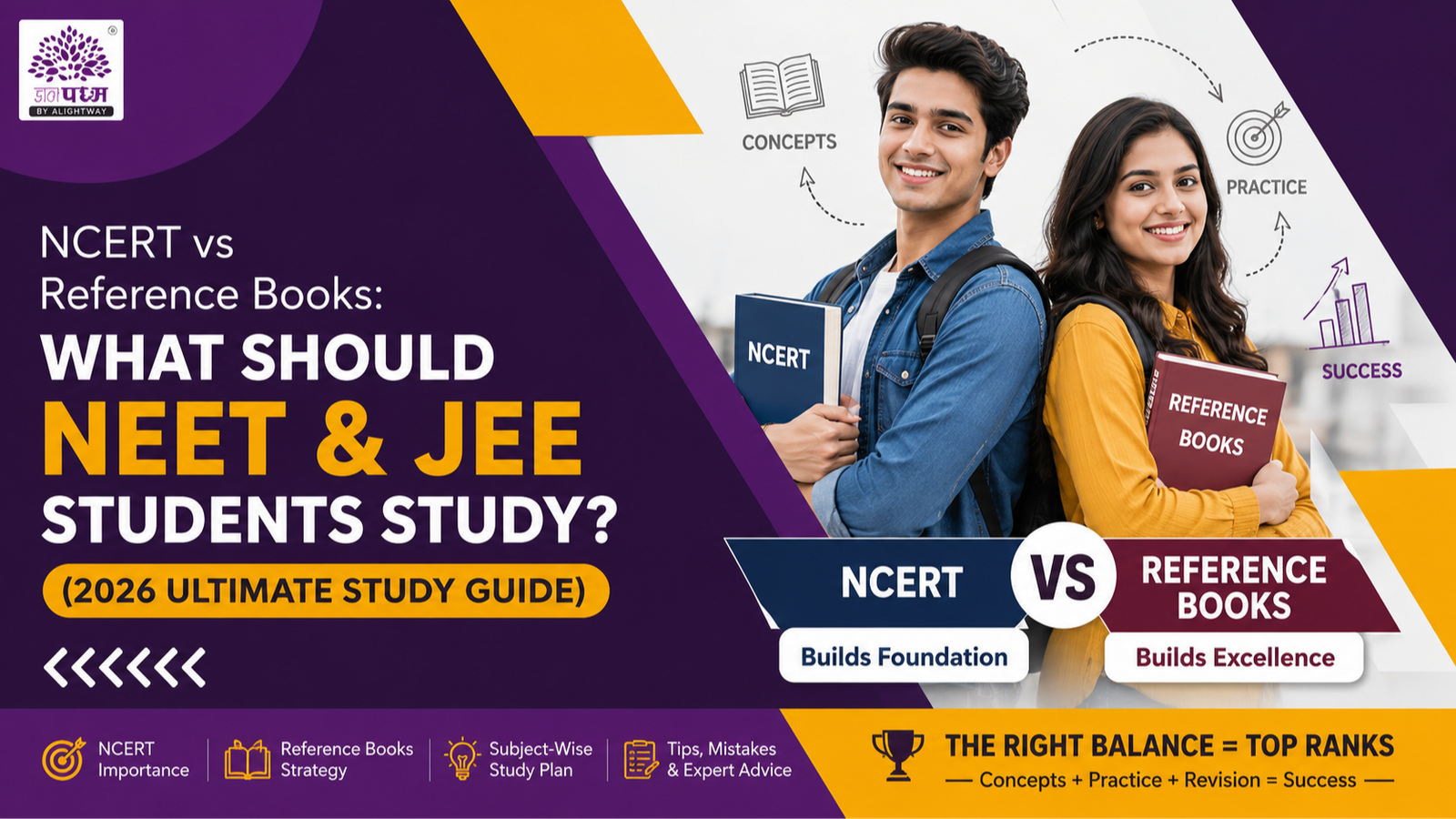
The truth is simple: Neither NCERT alone nor reference books alone can guarantee success. The right balance between the two is what helps students secure top ranks.
For some students, NCERT becomes the foundation that builds conceptual understanding. For others, reference books provide advanced problem-solving practice. Understanding when and how to use each resource can dramatically improve your preparation strategy.
This comprehensive guide explains the difference between NCERT and reference books, their importance for NEET and JEE preparation, subject-wise recommendations, common mistakes, and the best study strategy for 2026 aspirants.
Quick Answer: NCERT or Reference Books?
For NEET Aspirants:
NCERT should be your primary study resource, especially for Biology and Chemistry.
For JEE Aspirants:
NCERT builds fundamentals, while reference books are essential for advanced problem-solving and higher-level concepts.
The winning strategy is not choosing one over the other—it's knowing how to use both effectively.
What Is NCERT?
The National Council of Educational Research and Training (NCERT) publishes textbooks followed by most school boards across India.
NCERT books are known for:
- Simple language
- Conceptual clarity
- Structured learning
- Examination relevance
- Accurate fundamentals
They form the academic foundation for both NEET and JEE preparation.
What Are Reference Books?
Reference books are specialized books written by subject experts to provide:
- Advanced concepts
- Additional theory
- Large question banks
- Problem-solving techniques
- Competitive exam-level questions
They help students move beyond basic understanding and develop examination skills.
Why NCERT Is So Important for Competitive Exams
1. Strong Conceptual Foundation
Every advanced topic in Physics, Chemistry, and Biology begins with basic concepts. NCERT builds these fundamentals systematically.
2. Highly Relevant for NEET
A significant portion of NEET questions are directly or indirectly based on NCERT concepts, particularly in Biology and Chemistry.
3. Easy to Understand
NCERT uses simple language and logical explanations, making it ideal for beginners.
4. Saves Time
Instead of studying from multiple sources, students can focus on mastering the fundamentals.
5. Helps in Revision
NCERT books are concise and easier to revise multiple times.
Limitations of NCERT
Despite its importance, NCERT has certain limitations.
Limited Question Practice
The number of practice questions is relatively low.
Less Advanced Problem Solving
Some topics, particularly for JEE, require more challenging questions.
Limited Exam-Oriented Techniques
Students often need additional resources to improve speed and accuracy.
Why Reference Books Are Important
Reference books help students:
- Deepen conceptual understanding
- Solve difficult questions
- Learn multiple approaches
- Improve analytical skills
- Prepare for advanced examinations
They are especially important for students aiming for top ranks.
NCERT vs Reference Books for NEET
Biology
Winner: NCERT
Biology is one subject where NCERT is considered the most important resource.
Students should:
- Read every line carefully.
- Study diagrams.
- Revise multiple times.
- Learn tables and examples.
Reference books should be used mainly for additional practice.
Chemistry
Winner: NCERT + Reference Books
Physical Chemistry
Reference books help with numerical practice.
Organic Chemistry
Additional books improve conceptual understanding and reaction mechanisms.
Inorganic Chemistry
NCERT remains extremely important.
Physics
Winner: Reference Books + NCERT Fundamentals
Physics requires:
- Conceptual clarity
- Numerical practice
- Problem-solving techniques
Reference books play a major role in developing these skills.
NCERT vs Reference Books for JEE
Mathematics
Winner: Reference Books
JEE Mathematics requires:
- Advanced problem solving
- Multiple concepts
- Extensive practice
NCERT builds basics, but reference books are essential for higher-level preparation.
Physics
Winner: Reference Books
JEE Physics questions often demand:
- Analytical thinking
- Multi-concept applications
- Deep understanding
Reference books become crucial.
Chemistry
Winner: NCERT + Reference Books
For Chemistry, both resources are equally important.
Subject-Wise Strategy for NEET Aspirants
| Subject | NCERT Importance | Reference Books Importance |
|---|---|---|
| Biology | Extremely High | Moderate |
| Chemistry | High | High |
| Physics | Moderate | Very High |
Subject-Wise Strategy for JEE Aspirants
| Subject | NCERT Importance | Reference Books Importance |
|---|---|---|
| Physics | High | Very High |
| Chemistry | High | High |
| Mathematics | Moderate | Very High |
Common Mistakes Students Make
Buying Too Many Books
More books do not guarantee better ranks.
Ignoring NCERT
Many students underestimate the importance of fundamentals.
Following Multiple Teachers and Materials
Frequent changes create confusion.
Completing Books Without Revision
Revision matters more than collecting resources.
Solving Advanced Problems Without Basics
Strong fundamentals are essential before attempting difficult questions.
Ideal Study Strategy for NEET Aspirants
Step 1:
Master NCERT thoroughly.
Step 2:
Make short notes.
Step 3:
Practice MCQs.
Step 4:
Take mock tests.
Step 5:
Revise repeatedly.
Ideal Study Strategy for JEE Aspirants
Step 1:
Build concepts through NCERT.
Step 2:
Study advanced concepts from reference books.
Step 3:
Solve a large number of questions.
Step 4:
Take regular mock tests.
Step 5:
Analyze mistakes.
How Many Books Should a Student Use?
The answer is simple:
Fewer books, multiple revisions.
A common mistake among aspirants is:
- Purchasing many books
- Reading everything superficially
- Revising nothing properly
One thoroughly completed book is often more valuable than five partially completed books.
How Top Rankers Study
Successful students generally:
- ✅ Master NCERT first.
- ✅ Use limited reference books.
- ✅ Revise consistently.
- ✅ Solve thousands of questions.
- ✅ Analyze every mistake.
- ✅ Focus on quality rather than quantity.
Frequently Asked Questions
Can I crack NEET with NCERT alone?
For Biology, NCERT is extremely important. However, additional practice in Physics and Chemistry is generally beneficial.
Is NCERT enough for JEE?
No. JEE preparation typically requires extensive problem-solving beyond NCERT.
Should I study reference books from Class 11?
Yes, but only after building strong fundamentals.
Are multiple books necessary?
No. Too many books often create confusion.
Which is more important—concepts or questions?
Both are equally important. Concepts build understanding, and questions develop application skills.
Best Study Formula for NEET and JEE
- 40% Concept Building
- 30% Practice Questions
- 20% Revision
- 10% Mock Tests and Analysis
This balanced approach helps maximize performance.
Final Verdict: NCERT vs Reference Books
The debate should not be:
NCERT OR Reference Books
The real strategy is:
NCERT + Smart Reference Book Selection + Consistent Revision + Question Practice
For NEET Students
Prioritize NCERT.
Use reference books strategically.
Revise repeatedly.
For JEE Students
Build fundamentals through NCERT.
Master advanced concepts through reference books.
Focus heavily on problem-solving.
Final Thoughts
Success in NEET and JEE is not determined by the number of books you own. It depends on:
- Conceptual clarity
- Revision
- Consistency
- Practice
- Smart resource selection
The best students are not the ones who study from the most books—they are the ones who master the right books thoroughly.
Remember:
NCERT builds your foundation, while reference books sharpen your competitive edge. Together, they create a winning strategy for NEET and JEE success.